Cadwell’s Mountain: Grip, Crest and Commitment Without the Guesswork
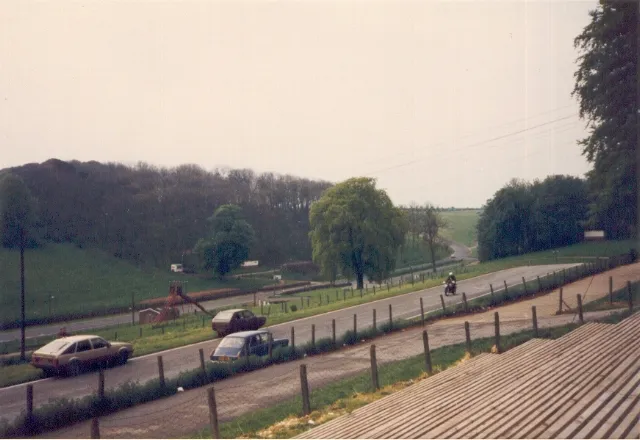
Photo: E Gammie, CC BY-SA 2.0, via Wikimedia Commons
Cadwell Park is one of those circuits that rewards a certain kind of discipline. The Mountain gets the headlines because it looks dramatic from the outside — the nose lifts, the horizon disappears, and for a moment the car seems to be steering by suggestion. But the quick way over it is not a bravery contest. It is a traction and setup problem, and like most traction problems it gets easier when you stop treating the throttle as an on/off switch.
The Mountain is a sequence: the uphill approach from Mansfield, the blind crest, the left-hand turn over the top, the landing compression, then the run down towards Hall Bends. Miss the first part and you spend the rest of it correcting. Get the approach right and the corner becomes almost calm.
The approach: slow enough to be fast
Most drivers brake too late for the Mountain on their first few laps, then arrive at the crest with the car still unsettled. The approach is uphill, so you feel like you have more grip than you do. You also cannot see the exit. That combination tempts you to carry speed you have not earned.
Pick a braking point you can repeat, not one that impresses your passenger. In the dry, aim to have the car straight and stable before turn-in. In the wet, move the braking point back by a good few metres and use a higher gear than you think you need. The goal is not to be slow; it is to arrive at the crest with the suspension loaded predictably and the tyres doing one job at a time.
Vision matters here more than at almost any other UK corner. Look past the crest to the landing point and the exit, not at the patch of sky where the bonnet is pointing. If you stare at the crest, you will lift. If you look through it, your hands tend to follow.
Turn-in and the crest
Turn-in should be smooth and slightly earlier than feels natural, because the car will go light as the road falls away. Do not add steering lock in a rush at the top. The front tyres are about to unload, and a sudden input will either wash the front wide or upset the rear depending on what is driving.
In a front-wheel-drive car, keep a light maintenance throttle through the crest. You want the front tyres pulling, not spinning. If the inside front starts to scramble, you are asking for too much. In a rear-wheel-drive car, the same principle applies but the risk is different: the rear can go light and rotate if you are greedy with the throttle. A neutral or slightly trailing throttle is usually faster than a brave stab.
The crest is not a place to change your mind. If you are going to lift, do it before turn-in or not at all. A lift at the top transfers weight forward, unloads the rear and can make the car feel like it is pivoting on a swivel. That is fine in a sim; it is expensive at Cadwell.
The landing and exit
The landing is where setup shows its hand. A car that is too low, too stiff or running too much tyre pressure will crash onto the bump stops and lose composure. You will feel it as a sharp jolt, a loss of steering feel, or a rear axle that suddenly wants to be somewhere else.
Keep the car straight as it compresses, then let the exit open. Do not add power simply because the worst looks over. Add it when the suspension has settled and the car is pointing where you want to go. In the dry you can be more aggressive with the exit; in the wet, feed the throttle in as if there is a glass of water on the roof.
Front-drive vs rear-drive
Front-wheel-drive cars usually feel more secure over the Mountain because the driven wheels are also the steered wheels, and a light throttle helps pull the nose through. The trap is wheelspin at the crest and understeer on the exit if you ask too much of the front tyres.
Rear-wheel-drive cars are more sensitive to the crest. The rear axle goes light, and any sudden torque can break traction. Smooth is not a cliché here; it is a lap-time strategy. If the car has a limited-slip diff, you may feel it lock and push you wide on the exit if you get on the power early.
Wet vs dry
In the dry, use the width of the track and trust the grip once the car is settled. In the wet, the Mountain becomes a lesson in patience. Short-shift, use a higher gear, and avoid the kerbs if they are greasy. The racing line in the wet is often not the dry line; look for the darker, cleaner tarmac and accept that the crest will feel even lighter.
Setup notes that actually matter
Tyre pressures are the first thing to check. Do not set them by what the internet says; set them by what the car tells you after a session. If the car feels skittish over the crest and the pressures are high, bring them down a couple of psi and see if the landing improves. If you are running a road tyre on a track day, remember that it will gain pressure as it heats up.
Damping matters more than most clubman drivers admit. Worn dampers will let the car pogo over the crest and compress too quickly on landing. A fresh set of dampers or a rebuild will not make you brave, but it will make the car predictable. Ride height is the other one: too low looks good in the paddock and feels terrible when the suspension bottoms out. Leave some travel.
Alignment can transform the Mountain. If the front toe is out of spec or the rear is crooked, you will be correcting the car rather than placing it. A proper geometry check is money better spent than another sticker.
Common mistakes
- Lifting at the crest because the horizon disappears.
- Turning in too late and then adding lock at the top.
- Running too much tyre pressure and blaming the circuit.
- Staring at the bonnet instead of the landing point.
- Using the kerbs in the wet because that is what you do in the dry.
- Trying to chase a lap time before you can repeat the same line three laps running.
A simple drill plan
Use your first session as a recce. Keep it at seven-tenths, pick a fixed gear for the Mountain and do not time yourself. The aim is to find a braking point and a turn-in point you can repeat.
In session two, work on vision. Look through the crest to the landing and the exit. If you have an instructor, ask them to watch where your eyes go rather than what your hands do. In session three, add throttle discipline. Start with maintenance throttle over the crest and only add power when the car is straight.
Confidence before lap times
The Mountain rewards the driver who arrives calm. That does not mean slow; it means deliberate. Once you can repeat the approach, the turn-in and the landing without a drama, the lap time will look after itself. Chasing a number before you have a repeatable line is how you end up in the tyre wall at Hall Bends wondering what happened.
Cadwell is a brilliant circuit because it asks questions of the driver and the car in equal measure. The Mountain is the best example. Treat it as a traction problem, not a test of nerve, and you will find there is more grip over the top than you thought — and more lap time in the landing than in the bravery.