The Empty Passenger Seat Is Talking: Corner-Weighting a Right-Hand-Drive Track Car
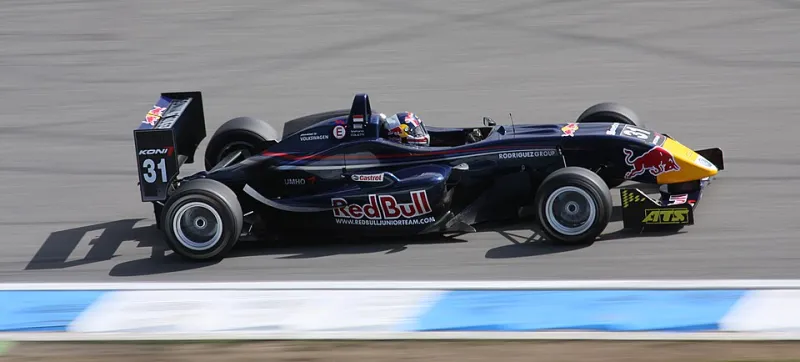
Photo: user:AngMoKio, CC BY-SA 2.5, via Wikimedia Commons
Walk down any UK paddock on a track day and you’ll see the same thing: a right-hand-drive car, one driver, and a passenger seat doing nothing. That empty seat is a setup clue. The driver’s weight sits on the right and on one diagonal, so the static load at each corner is never symmetrical. On a road car you ignore it. On a track car, it’s part of the baseline.
This isn’t about chasing a perfect 50/50 cross-weight. It’s about making the asymmetry repeatable, understanding what it does under braking and turn-in, and knowing when to stop fiddling.
Start with the car as you run it
Corner-weighting only means something if you measure the car in the state you’ll drive it. That means driver ballast in the seat—sandbags, water containers or proper lead, secured so it can’t move—fuel at a known level, tyre pressures set to your usual cold track pressures, and the same damper and anti-roll bar settings you’ll use. If you normally drive solo, weigh it solo. If you always carry a passenger for sighting laps, decide which state is your baseline and stick to it.
You need a flat, level patch. Four proper race scales are ideal; borrowed scales from a friendly preparer are fine. A sloping driveway is not fine. Roll the car back and forth a metre after settling it so the suspension isn’t binding. Keep the steering centred. Record everything.
The home routine
- Set tyre pressures cold to your track-day starting pressures. Note them.
- Put fuel in at a fixed load—say half a tank—and write down the litres.
- Ballast the driver’s seat to your weight, secured.
- Lower the car onto the scales and bounce each corner gently.
- Read each corner, total weight, front percentage and your chosen diagonal percentage. I log the driver diagonal—right-front plus left-rear divided by total—because that’s the pair carrying the driver. Whatever your scales call it, log the same diagonal every time.
Then make one change. A quarter-turn on a spring perch, a small ballast move, or a ride-height tweak. Re-settle, re-read, write it down. If you change three things at once, you’ve learned nothing.
What cross-weight actually changes
Cross-weight is a diagonal load split. It doesn’t add grip; it moves load around. On a right-hand-drive car with only a driver aboard, the driver diagonal is usually heavier. That can make the car feel secure on one side and vague on the other, especially during the transition from straight-line braking to turn-in.
Watch for clues rather than absolutes. Does the right-front lock or trigger ABS earlier under threshold braking? Does the car pull left under braking, or feel lazy turning right? Does it feel planted on right-hand entries but nervous on left-hand ones? Those are symptoms. Cross-weight may be part of the story, but so are tyre pressures, alignment, damper settings and the camber of the corner.
A small cross-weight change—0.3 to 0.5 percent—can be felt through the seat and the brake pedal. A big swing will change the car more, but not always for the better.
Ballast: use it, don’t decorate it
Ballast is the easy lever on a road-based track car with no adjustable perches. Moving 10 kg from the passenger footwell to the left rear changes the diagonal split. But ballast also adds mass, and mass is never free. Secure it properly—bolted brackets or a proper ballast box, not a gym bag on the seat. If your championship or track-day insurer has rules about ballast, follow them.
Don’t add 40 kg just to make a number look neat. Use the smallest amount that gives a repeatable, predictable car. If you can adjust spring perches, use those first and keep ballast for fine-tuning.
Fuel, pressures and the UK reality
Fuel load changes rear weight and cross-weight. Ten litres is roughly 7.5 kg, and that’s enough to shift your readings. Pick a fuel level you’ll actually see on track—half a tank is a sensible baseline—and note how the numbers move when you burn it off. If you qualify on low fuel and race on full, you need two baselines.
Tyre pressures don’t change static weight much, but they change ride height and contact patch. Set them cold, consistently. UK weather adds another variable: a cold morning at Snetterton will give different pressures by the afternoon. Corner-weight the car at a known temperature, then manage pressures at the track as normal.
And remember the tarmac. A car that’s perfect on flat scales can feel odd through the dip at Paddock Hill or the crest at Cadwell. UK circuits are not test rigs. Your baseline should be stable enough to cope with camber, kerbs and fuel burn—not so finely tuned that a half-tank change ruins it.
When to stop
Stop when the car brakes straight, turns in consistently both ways, and your lap times are repeatable. A 50/50 cross-weight is a workshop number, not a lap time. If you’re chasing the last 0.2 percent and the car feels worse, you’ve gone past the useful window.
Corner-weighting a right-hand-drive track car is really about honesty. The driver is a setup item. Weigh the car as you drive it, log the asymmetry, make one change at a time, and judge it on UK tarmac—not on a spreadsheet. Then go and spend the saved time on tyres, brakes and seat time.