Half-Dry, Fully Committed: Reading the Crossover at a UK Circuit
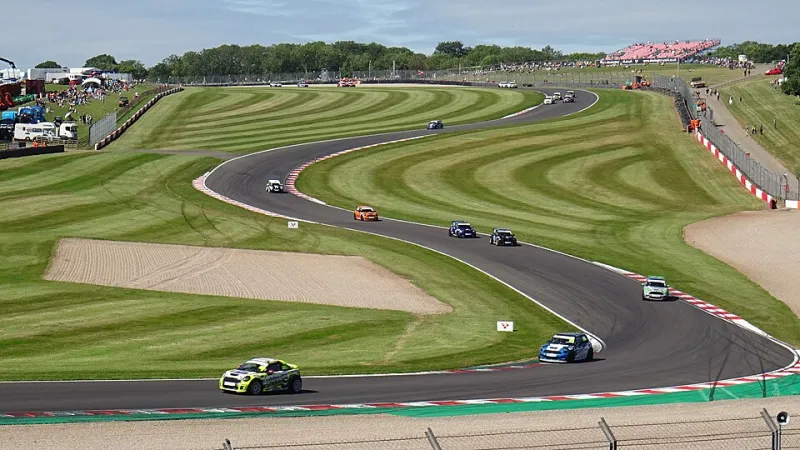
Photo: BWard 1997, CC BY 4.0, via Wikimedia Commons
A damp November track day at Donington or Oulton can feel like three circuits in one afternoon. The morning is properly wet, lunchtime is a patchwork, and the last session is dry enough for sticky tyres and brave brake markers. The tricky bit is the middle. That’s when the fast line starts moving, and when plenty of UK drivers lose more time chasing a dry patch than they would by staying on the damp line.
The track is not a switch
We talk about wet lines and dry lines as if a marshal throws a lever. In reality, UK tarmac dries unevenly. Tree cover keeps one corner damp while the next is ready for a dry entry. Camber pulls water across the racing surface. Rubber that was laid down in the morning can turn greasy when it gets a light soaking. And the line that worked ten minutes ago might be the slowest part of your next lap.
The useful mindset is not ‘when is it dry?’ It’s ‘where is it drying, and what is that doing to my car?’ That question keeps you looking out of the windscreen instead of staring at the dash.
Use sighting laps as a survey
On a track day, the first lap out of the pits is usually treated as a warm-up. Treat it as a recce instead. You’re not looking for lap time; you’re building a water map.
Scan for sheen, reflections and the darker patches that stay wet longer. Look at where water is being pulled off line by other cars. Note which kerbs are holding standing water and which are merely damp. On a circuit like Brands Hatch, the top of Paddock Hill can feel dry while the exit holds moisture under the trees. At Snetterton, the long straights can dry quickly while the slower corners stay slick.
Pick two or three reference points per corner: entry, apex, exit. If the apex is dry but the entry is still wet, that’s not a dry corner. It’s a compromise, and you need to drive it like one.
Tyre feedback beats optimism
The car will tell you where the grip is before the lap timer does. A light, vague steering wheel on turn-in usually means water is still sitting on the surface. A rear that steps out under gentle power is telling you the exit is not ready. If the car feels planted on the damp line but nervous the moment you move offline, believe the nervousness.
Road-legal track tyres and semi-slicks are especially sensitive to this. They can cope with a damp surface, but they don’t clear water like a proper wet tyre. If you feel aquaplaning through a fast section, that’s not a cue to be brave. That’s a cue to stay on the line that has already been cleared by traffic.
Also, don’t confuse cold tyres with a wet track. On a chilly UK morning, a dry-ish tyre can still feel wooden for a lap or two. Get temperature into them before you decide the track has changed.
Standing water and the patches that lie
A dry-looking patch is not automatically a grip patch. It might be sealer, a repaired section, or rubber that has gone slick with moisture. If it looks shiny but not wet, be suspicious. If it looks dry but the car slides across it, you’ve found a false friend.
Standing water is more honest. You can see it, and you can hear it. If a puddle is across the line you want to use, don’t force the car through it just because the rest of the corner looks dry. The time you gain on the dry part can vanish in one aquaplane.
Pay attention to run-off and kerbs too. Water running across the track from the grass can keep a corner damp long after the racing surface looks ready. That’s classic UK circuit behaviour, and it’s why the fast line often stays a metre away from the kerb.
Lap time is the honest scoreboard
Feel is useful, but lap time is the check. Compare sectors, not just full laps. If you move to the dry line at one corner and gain a tenth, but lose four tenths in the next sector because you’re crossing a wet patch, the dry line is not working yet.
Be consistent for a few laps before you draw conclusions. One hero lap on a drying track can flatter a line that is actually slower and riskier. Look for a trend: three laps where the dry line is consistently faster, with the car feeling stable, is a signal. One lap where it felt brilliant and two where you ran wide is not.
don’t chase the lap timer into a wet patch. If the drier line requires you to cross standing water at entry, the gain on exit has to be enormous to make it worthwhile. Usually it isn’t.
When staying damp is the quick call
There are plenty of times when the damp line remains the fast line even as patches of dry tarmac appear. If the car is balanced and settled, don’t destabilise it for a small dry patch. If the crossover point is still holding water, stay committed to the line you know. If traffic is already clearing a damp line, use that work rather than blazing a new trail through the wet.
This is especially true in short sessions. If you’ve got five minutes left before the chequered flag, experimenting with a half-dry line is often just a way to lose the lap you already had. The track might dry properly for the next session. Let it.
A simple crossover routine
On the out-lap, build your water map and identify the wettest parts of each corner. For the next few laps, run the damp line consistently and note where the car feels strong. Then move one element at a time: entry first, or exit first, never the whole corner at once. Check the sector time and the car’s behaviour. If you don’t gain after two clean laps, go back to the damp line.
That routine sounds slow. It isn’t. It stops you from spending a session chasing a dry line that isn’t there yet, and it keeps the car pointing the right way while the track makes up its mind.
UK weather rarely gives you a clean crossover. The fast line moves, the grip moves with it, and the drivers who read the transition early are the ones who look smooth when everyone else is guessing. Stay patient, watch the surface, and commit only when the car and the clock agree.