TTC, Decoded: Traction, Setup and Track Craft for UK Track Days

If you typed /ttc/ looking for a quick answer, here it is: TTC is Team Traction Control, and the name is basically the brief. We write about traction, setup and track craft for UK track-day drivers and amateur racers. Not miracle parts, not borrowed lap times from someone else’s car, and not a podium speech before you’ve done a sighting lap.
The useful version of TTC is a way of thinking. Every lap time is the result of three conversations: what the tyre can take, what the car is doing with the load, and what you’re asking it to do at the next corner. Get those three talking properly and the car feels calmer, the lap feels slower, and the stopwatch usually disagrees. That’s the whole trick.
Traction is a budget, not a switch
Traction gets treated like a binary thing — you either have grip or you don’t. In reality it’s a budget you spend through a corner. You can spend it on braking, on turning, or on getting back on the power. You can’t spend it twice. A lot of UK track-day frustration comes from asking the front tyre to turn while asking the rear tyre to put down power before the car has actually settled.
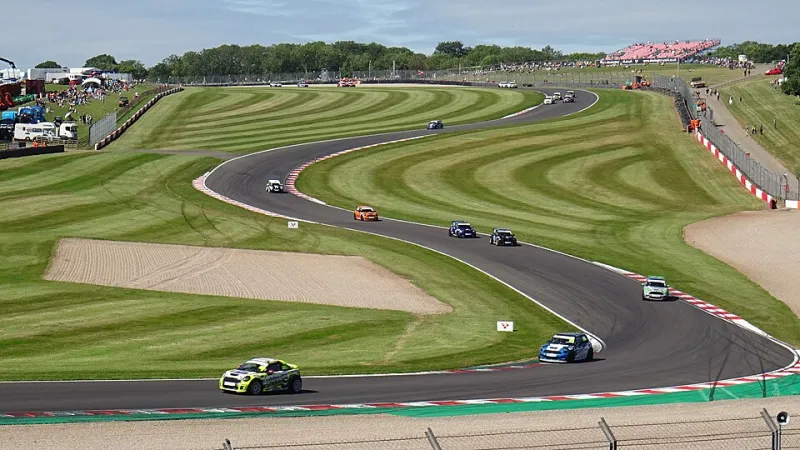
At somewhere like Brands Hatch, that shows up in the slower corners. At Donington, it shows up on the exit of the final hairpin and through the Craner Curves sequence. At Snetterton, it shows up in the long corners where you’re tempted to feed throttle early because the car feels stable. The fix is rarely a new tyre or a magic alignment number. It’s usually a timing problem: you’re asking for traction before the platform has finished moving.
A good drill is to pick one corner and separate the phases. Brake, release, turn, wait, throttle. Do it deliberately slowly. If the car feels dull, don’t add speed yet — add precision. The point is to feel when the suspension has taken a set and the tyre is ready to work. That moment is where traction starts, not where your right foot thinks it should.
Setup is a language for what the car is telling you
Setup advice gets complicated because people describe feelings, then translate those feelings into parts. “It’s nervous” can mean a tyre-pressure problem, a damper problem, too much rear brake bias, or a driver who’s still carrying brake pressure into the corner. The setup sheet can’t tell the difference. Your notes can.
That’s why we keep coming back to simple evidence: pressures on the day, tyre temperatures across the tread, damper adjuster counts, brake-bias marks, fuel load, and the corner where the problem actually happened. One lap of a UK circuit can contain three different types of tarmac, two kerbs that upset the car in different ways, and a surface change that makes the same setup feel brilliant in the morning and vague after lunch.
Setup isn’t about finding the one perfect number. It’s about finding the direction that makes the car more predictable for you. A car that’s slightly slower on paper but gives you the confidence to commit one metre later into a braking zone is usually the faster car by the end of the day. That’s not a philosophy — it’s just how track days work when you’ve got limited laps and a long drive home.
Track craft is the bit you can practise without buying anything
Track craft is the bit that gets left out because it’s harder to photograph than a coilover. It covers braking references, vision, car placement, overtaking discipline, warm-up laps, cool-down laps, and knowing when to come in. It also covers the paddock side: checking noise limits, keeping the car quiet on the drive-by, and not being the person who causes a session stoppage because a wheel arch liner decided to leave the chat.
On a UK track day, track craft often looks like restraint. It’s doing a proper out-lap when the tyres are cold and the brakes are still waking up. It’s noticing that the sun has come out and the tyre pressures have moved. It’s accepting that the fastest line through a corner might not be the line you can repeat for ten laps. And it’s understanding that the driver in front may be quicker in one sector and slower in another, so a pass needs a plan rather than a prayer.
The practical version is a small notebook or a phone note. After each session, write down one thing that worked and one thing that didn’t. Not “car understeers”. Write “understeer on turn-in at the first corner after three laps, worse when I stay on the brakes”. That’s a setup note and a driving note in one. It gives you something to test next time instead of a vague memory and a forum thread.
How to use TTC
Use the site like a workshop, not a catalogue. Start with the problem you actually have. If the car feels inconsistent, read about tyre pressures and damper behaviour. If you’re losing time in one corner, read about braking references and vision. If you’re changing parts every weekend, read about setup audits and evidence.
The three pillars connect. A traction problem might be a setup problem. A setup problem might be a driving problem. A driving problem might just be a cold tyre and a rushed out-lap. The sooner you can tell the difference, the less money you’ll spend and the more useful your track days become.
And if you only remember one thing, remember this: fast laps are made by boring consistency. Get the car settled, get your references repeatable, and let the stopwatch catch up. That’s TTC in a sentence — traction, setup and track craft, in that order or whichever order the lap needs.